Hello! I have a new job. I’ve had a new job since November. Eventually I will update people about it, my plans, and goals. I also intend to be around here this summer to blog my adventures at the ALA annual and my adventures in learning how to be a good instructional librarian!
Summer 2013 Summary and Wrap-up

History Collection Display
I had a rather good summer at TPL. It came to a close with my promotion! While I have been doing the work of a librarian (as my boss has been telling me) I now have the title! And the raise, which is great. I am, however, still looking for another part-time job …or a fulltime one someplace else, as sad as I’d be to leave TPL!
With this new title, I’ve also taken on new collections that I order for. Weeding is on hold right now, due to a lack of staff members. As much as that bums me out, I don’t think I could tackle all my collections on my own right now! Here is the run-down of what I’m now ordering:
· 200s
· 330s-390s
· 790s
· 900s
· Science Fiction and Fantasy
· Mass Market paperbacks
· Trade paperbacks
· EBOOKS!! (via Overdrive)
I am not overwhelmed, yet. The excitement is carrying me through. Also, all of the non-fiction is ordered through the end of October, saving for patron requests that I approve. Ebooks are ordered (roughly) twice a month. Since TPL is a part of the Midwest Collaborative for Library Services package I am only ordering extra titles, requests, and (thanks to a generous eBook budget) a few other titles. Particularly when it comes to teen related material.
I had fun with displays, which always prove enjoyable to me. I had an incredibly popular (and simple) romance display that I could not keep stocked! I also waged a quiet war against the notion that the genre of romance was a silly one. Psh, not on my watch! I also had several less successful displays; one on history and another with music CDs. While CDs remain a hot item at our library, I have a feeling people just weren’t that interested in what I put up there. I forgive them, I have strange taste in music. The history display, well, it should have been amazing. I think if I had done something more eye catching I could have at least gotten more traffic to it. The premade sign just wasn’t that interesting or visually attractive. Anyway, I’ve got a banned books week display on taps next, I hope it will prove to be more interesting to patrons.
I taught my first classes this summer, as a part of a two week “Job Seeking Skills” class. It was with a class of 16 adult job hunters, who had mid range to beginner computer skills. The courses covered everything from basic Word skills to writing a resume and cover letter. I taught specifically on how to job hunt using the internet. Monster, Indeed, ect, as well as how to create and maintain profiles on company and organization websites. It was a great experience for me, as I had an outline of what I needed to teach, but was allowed to do so as I pleased!
I am also planning my first adult programming! It’s all set up, save for the marketing. I am having a speaker come in and give a demo on how to make your own chocolate candies at home. I anticipate it being popular, as there will be prizes and you get to taste the candy we make!
2013 Projects – Blind Date with a Book
 I did a Blind Date with a Book display in April, it went over really well. I was pleased. The books were wrapped and had a few key words on the cover, to give a sense of the book, without giving too much away. 31 of the 47 books circulating in just over three weeks. The books were marked as “unavailable” in Polaris, so they needed to be checked in before they were checked out, but patrons and circ staff were fine with the slightly added check out time.
People I spoke with generally seemed to enjoy the idea, even if they did not check out a book off the display. Strictly in an observational sense, many people stopped and looked at the display.
Total time spent on the display from set up to take down was about 6 hours, so it was time consuming. Two quick things could make this faster; the first would be to pre-select the books (which I did not do, I just pulled shiny looking books and some of my favorites) and have a page pull them, and the second would be to enlist volunteers to wrap the materials.
I think if it is done again in the future it might go over well as a summer reading event or tie it in with February around Valentine’s Day. I’d also love to do one for teenagers, if given the chance!
2013 Projects – Teach Yourself Microsoft Office @ TPL
 For my Advanced Online Searching course, in conjunction with work, I created a pathfinder on self-teaching Microsoft Office. Our classes are currently at hold in my workplace, and this was in part to show our patrons we still care about their computer education. It was successful, and I found that patrons were pleased to have this information about our library services on hand. I hope to set up shorter pathfinders on setting up different social media and email accounts, for an upcoming technology program at work.
You can see the full handout at this link.
The hardest part about this project was simply time involved in formatting. The materials themselves were easy enough to put together.
2013 Projects – Books on the Go

The best of the lame clip art available for the project.
The biggest project (beside graduating) that I’ve tackled this year was was the revamping of Troy’s Books on the Go book group kits. Of the previous twenty-odd kits, many had gone missing or were no longer circulating. The bags were in disarray, and it was generally an underused collection. When my boss asked me to select some new titles for consideration, it was simply exploratory; I did not expect it to turn out to be such a massive undertaking.
My first steps were to discover what local book clubs, and groups around the country, would be reading the coming year. I gathered my titles and narrowed it down to about 20 items, sending it off to my boss for her perusal. I was surprised when she told me she wasn’t going to make any changes, and even more surprised when I was informed to start ordering them!
Hours of time later, I realized that not all 20 items would be possible to get in an affordable fashion. A decision was made to get things available in paperback only. I made a few substitutions and ended up with 16 titles from the original twenty, with two titles that we would source from copies we already held.
My boss suggested new bags, which I was more than happy to track down, as the small tote bags from past kits were dingy and looking pretty bad. By the end of the day I had sent her a list of options, and within a week or two, we had approval to order them We ended up with these great zipped canvas tote bags that are really going to hold up to a bag of 12 or more books!

The hardest thing about this project was putting everything together. The display needed to be set up with a binder of book summaries and discussion questions, processing needed to happen both in Tech Services, and then more on my end. Barcodes needed to be added to the bags, discussion questions needed to be laminated and added, displays needed setting up. It took at least two shifts for everything to come together. Much to my surprise, 7 of the kits already had holds on them!
For those curious, here is a link to the list of the books/binder cover.
I’m really looking forward to getting feedback on this project from patrons, and I hope these kits will hold up over the next few years.
LIS 7160: Criticism on Chapter 7 “Abilities with Disabilities” of The Reference Interview Today
Citation for the text: Knoer, Susan. The Reference Interview Today. Santa Barbara, Calif.: Libraries Unlimited, 2011.
I felt the need to explain some of the criticism I am leveling at this chapter. First, I’d like to address the issue of “empathy training.” No person without a disability can accurately talk about the issues and troubles a person of that community faces. My experiences will be nothing like what a person who is blind experiences. To appropriate their experiences is problematic, because it leads to a very shallow understanding of the issues at hand and can lead people to underestimate actual challenges and issues people face on a daily basis.
While this kind of training may be well suited for children, to help them understand the need for empathy for those who are different; an adult who will be making policy decisions based on this training, has the potential to harm those they are trying to help.
As I’ve stated in other blog posts, as information professionals,
We need to educate ourselves on our library population, including the aged and disabled. We cannot expect them to be our sole educators, it is not their responsibility. A culture, be it an ethnic or social culture, should not be held responsible for the ignorance of outsiders. They should not suffer due to the ignorance of outsiders. I cannot presume to know what a person with disabilities faces on a daily basis that prevents them from accessing a library or information agency. However, I can speak with those who are disabled, and have.
From, “Reaching Out to Disability Culture.”
Secondly, I take great issue with the suggestion that we lie to our patrons, if they do not speak in a way that we can understand them. This can go for people who speak differently due to a disability, or someone with a heavy accent To blame the background noise, in what is generally a quiet library, is offensive.
A situation like this is more complicated to explain why it is a flawed suggestion. However, I feel that you would be doing the patron a great disservice to lie. Instead, ask them to write it down, or yes, repeat themselves.
LIS 7850 Final Blog Post
As we close on the semester, I’ve focused a lot on education, community, and social justice within my studies of universal access and library services to people who are disabled and older adults. I’ve realized that there are many different things that librarians can do to help these populations, but the biggest one is to educate ourselves.
We must educate without belittling or lessening the experiences that others face in their day to day life. It is important to understand and support, without ever assuming that we truly understand what populations different to us goes through. We must actively work to change the cultural idea of what “normal” is to include a wider range of people than it currently does, in all levels of society.
This means being aware of what micro-aggression is, and how to avoid behaving in similar ways. It means having some idea that books written about people who are disabled may not be accurate representations, and therefore perpetuate painful stereotypes. Educating ourselves also involves and understanding of the resources people have in our communities, and how the library can reach out and harness these resources, to provide a full and engaging experience. While also keeping aware of the fact that sometimes, the services we provide are not accessible. However, our education will help us make these services more open.
When I started this class I was asked to write out a handful of assumptions, an assignment I balked at, because I know assumptions are often unsafe to make. I came up with the following:
1) Disabilities manifest differently for every person. Two people may have the same disability, but it will manifest with its own unique challenges and issues.
2) Aging presents its own set of issues and challenges that cannot always be addressed in a blanket fashion.
3) Being old, or being a person with a disability does not have to affect your quality of life.
4) There is just as much diversity in aging and disabilities as there is in other identities.
All of my assumptions have remained the same throughout the course of this class. If anything, the readings, course material, and other assignments of this class has only served to propel these assumptions into firm truths. I have been made aware of a wider range of issues, challenges through this class than I was before. I am also well on my way to a better understanding of how to counter these issues, and to create a library environment that is welcoming to a wide range of people of varied abilities
Universal Access
Universal access is the concept that physical buildings, technology, information, and many other things should be open and accessible to those who are physically disabled or have other issues from preventing access in a traditional manner. It is an idea that needs to take root in society, as even with the technologies and advances we have made, there is still a large barrier when it comes to people who fall outside of a “normal” preconceived notion of ability and ability levels.
Universal access is the concept that buildings should be barrier free, beyond just ADA compliant, but properly accessible to people of all types. It is the idea the computers should be easily adaptable for people who have low or no vision, and limited mobility. It also pertains to things like websites, presentations, and documents; that there is an uncomplicated way for people who are disabled to access the information provided on these materials. The ADA mandates that buildings be accessible, yet there are some situations were buildings can be grandfathered in to be non-compliant. In other situations, even if the buildings meet ADA codes, does not mean they are practically accessible.
However, in the situations such as educational materials, websites, and virtually everything else, are often not accessible. This provides the biggest issue for libraries and information agencies. There are many ways to make buildings more accessible, and things such as furniture and software on computers. Yet, making buildings more open, including furniture and other settings, are expensive and often hard to retrofit. Technology is costly to purchase, and hard to retrofit. On top of that, these items then have to be marketed, which takes staff time and additional funding.
Sadly, this all falls to the clients, leaving them as underserved within the library. Buildings, even accessible ones, provide different hassles of navigation. Computer labs will not have the software needed to make computers fully accessible. If a library does have these services, the marketing might not reach the people who need it most.
As librarian professionals we need to be aware of little changes we can make, and educate ourselves. This will allow us to look at our workplaces, down to the physical buildings, to the materials that we but out, more open and accessible to a wide range of people.
Outreach and the Library

Image from Wikimedia Commons
I’ve addressed my local library and its outreach to seniors in a previous blog post. So for this post I’m going to turn to a library outside of the Detroit area, Rochester Hills Public Library. I was exceptionally impressed with RHPL’s library service for older adults.
RHPL has an Outreach Coordinator, who is in charge of services to senior adults, as well as services to the disabled community and is in charge of running a bookmobile service. They work hard to make sure that older adults are connected to the library and they have services that are geared toward them.
Within the main branch, there is a dedicated room for outreach services, which is where most of the services for the senior community are organized. This room includes their large print collection, computers, a home health care library, relevant magazines, and assistive devices to aid in reading. RHPL also has mini-branches in each of the designated senior living complexes in the area that they support. There is also one located in the community center for older adults. These branches are run by volunteers within the communities and provide access to large print, audio book materials, as well as bestsellers, DVDS, and other paperbacks. RHPL have book cards for residences where the patients may be room/bed bound, where they can pick a selection of books, audio, and movie materials off a mobile cart on a twice weekly visit.
These stations are more than just a collection of books, and allow greater access to materials to patrons who might not be able to make it to the main location. They also provide excellent opportunities for older adults to become engaged in their communities and participating and staying active. This type of partnership, between the housing complexes and the senior living center is a brilliant partnership that more libraries could think of fostering.
There are additional situations to provide programming directly at these mini-branches, depending on size of the branch. These could be educational or entertainment events, which will allow people to remain connected to one another and engaged in discussion. Not only will people be able to enjoy the programming, but they could enlist volunteers from the housing complex and senior centers, which provide an even better opportunity to stay involved. Nurturing a community is can, and should be, an important role for libraries.
The Digital Divide with Older Adults and People who are Disabled.
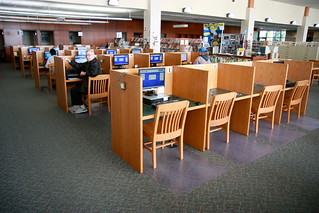
image courtesy of Lester Public Library
As an adult child of a woman who has learned to use Facebook in the last year or so, I am very well acquainted with the digital divide between older adults and those who have grown up with computers in school and at home. There is nothing more frustrating, on both sides, to see a parent post something meant to be a private message as a status, after explaining the difference over and over! Yet the issue is much more serious than accidental Facebook posts or regular email forwards from parents. To employ a bit of hyperbole for a moment, the world (or at least most of mine) seems to be run via the internet. To know that there are still large populations of the United States who are non-users, be it through lack of access or understanding, is a problem. As an information professional, it is my place to be a part of the solution. First, however, let me address some important background and statistical information.
The National Telecommunications and Information Administration (NTIA) from 1995 to 2000 published a series of reports that first started to detail this growing gap between people who have access to technology and the internet, and those who do not. The final report stated,
Each year, being digitally connected becomes ever more critical to economic and educational advancement and community participation. Now that a large number of Americans regularly use the Internet to conduct daily activities, people who lack access to these tools are at a growing disadvantage (2000).
The Pew Internet Project picked up where the NTIA survey ended. In a report released earlier this year, Pew looked into this trend of a digital divide. While the report indicates the gap is closing, it is still highly significant.
In 2000 12% of adults over the age of 65 accessed the internet, in 2011 that number increased to 41%. Age is one of the biggest factors in determining if a person has access to computers and the internet. The other major factors are lack of a high school education and living close to, or below the poverty line. The Pew Internet Project also reports that of 48% of non-users report that main reason they do not use the internet is not relevant to their lives, or in other words, they have no use for the technology. This is followed (in order or percentage reporting) by the cost of using internet, usability issues, and finally by lack of access and availability. These statistics also take into account access to different mediums for internet access, such as tablets, computers, and mobile/smart phones.
In regards to disability, the Pew Internet Project reports that:
The 27% of adults living with disability in the U.S. today are significantly less likely than adults without a disability to go online (54% vs. 81%). Furthermore, 2% of adults have a disability or illness that makes it more difficult or impossible for them to use the internet at all.
Furthermore, even after they’ve controlled for demographic issues such as income and education, the number is still disproportionately high.
These numbers are exceptionally important for information professionals to be aware of, in particular the public library sector. While we cannot put a computer and internet in everyone’s hands, we can provide access through our public computer services. We provide education by offering both classes to groups of our patrons, but also through short one on one instructional sessions.
Both older adults and people with disabilities are those we can reach out to, and make the library an inclusive place for them. It is my experience that the local libraries in my area are trying to reach out to the older demographic. With free computer and internet use, free or low cost beginner classes, and programming to engage older adults. This trend needs to remain, and it needs to have continued support to remain viable. Examples for future ideas could include reaching out to senior centers to offer classes on computer usage just for members of those facilities.
However, I see a disturbing lack of support for people who are disabled. Yes, many libraries have outreach programs. Yes, most all libraries are ADA accessible. Yet just because a building is considered accessible through ADA codes, does not mean that it is actually accessible in practice. This is, I hope, largely a budgetary/space issue, and not just apathy. Although, I do believe apathy or ignorance plays a large role in facilities that remain difficult to access.
Beyond actual technology library facilities, particularly pavement, sidewalks, and doors should always be well maintained. Cracks in the cement, awkward ramps, and broken automatic doors can make navigating in a wheelchair or with a walker difficult to the point where someone may decide not to enter the facility.
If a library has a computer lab, there should be an effort to have at least one (if not more, depending on size of the library) computer that is equipped with an adjustable desk, screen reading software, and magnifying abilities. Keyboard, mice, and mouse trackpads that are easy for people to use with limited mobility would also be valuable additions to any computer lab. It is not enough just to have these items, however. They should be marketed in library promotional materials and passed around to relevant community sources.
In the end, libraries in the United States are there to support access to information, and we need to do our best to provide access to all members of our communities, not just the members of the communities who are the easiest or largest populations to assist.
Bibliography
National Telecommunications and Information Administration (DOC), W. C., & Bureau of the Census (DOC), W. n. (2000). Falling through the Net: Toward Digital Inclusion. A Report on Americans’ Access to Technology Tools.
Zickuhr, K., & Smith, A. (2012, April 13). Digital Differences. In Pew Internet & American Life Project. Retrieved November 12, 2012, from http://www.pewinternet.org/Reports/2012/Digital-differences.aspx


